Sweet corn and specialty corn breeding for northern Vietnam
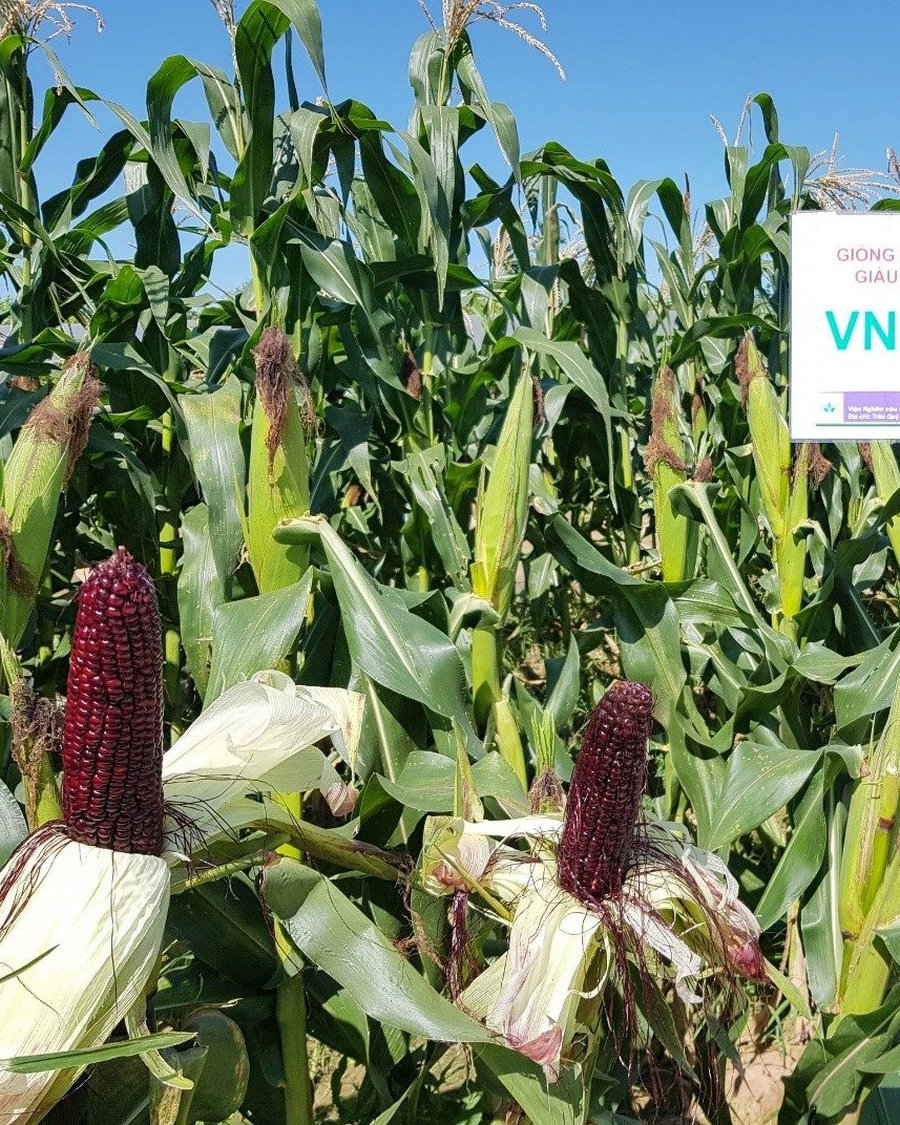
Breeding of purple waxy corn, anthocyanin-rich sweet corn, and white-, purple- and black-kernel supersweet corn at VNUA. Parents and hybrids are chosen with multivariate analysis of field traits, SSR markers, and combining-ability and gene-action studies. Team member on three grants: the Ministry of Science and Technology’s “Research and breeding of purple waxy corn and super-sweet corn varieties for northern provinces” (ĐTĐL.CN-09/21, 2021–2025, completed), MARD’s “Breeding of anthocyanin-rich fresh-eating sweet corn varieties for northern provinces” (2023–2026), and Hanoi People’s Committee’s “Research and development of high-quality fresh-eating sweet corn varieties for Hanoi City’s agricultural product brand” (CT04/01-2024-5, 2024–2028). Secretary of the VNUA key project “Development of breeding material for specialty sweet corn based on phenotype and molecular markers” (T2022-41-06TĐ, 2022–2024, completed). This breeding work has produced five hybrids recognized for circulation, four of them also protected, and a series of genetics and breeding papers, including a Journal of Crop Science and Biotechnology study on the white-, purple- and black-kernel supersweet lines.
Image-based phenomics and AI-assisted breeding decision support
Principal investigator, “Preliminary research on image-based phenotyping, big-data construction, and application in crop breeding” (T2021-41-15TĐ, VNUA, 2021–2023, completed). The project aimed to use image-based, high-throughput phenotyping and machine learning to measure traits for selection quickly and consistently. A single-author review in Ecological Genetics and Genomics (2026) proposes a “breeding digital twin” framework that ties predictive models to crossing, trial, selection, and release decisions, using sweet corn as a test case.
Sweetpotato and other tuber crops
Leads VNUA’s Strong Research Group “Research and development of potential tuber crops” (NCM2024-39), set up in 2023, and is a team member on the VNUA key project T2024-41-25TĐ, which funds part of this work. A 50-accession sweetpotato germplasm panel has been evaluated with MGIDI multi-trait selection and SSR fingerprinting. The work has produced four manuscripts: a data descriptor (Data in Brief), the main selection analysis (PLOS ONE), a method article (MethodsX), and a short review of AI-assisted genomic selection in sweetpotato, a hexaploid, clonally propagated crop. The review is published in Ecological Genetics and Genomics, and the Stage-3 genomic-selection pipeline it describes is released as a reproducible code archive, tested so far on simulated data. The other three manuscripts are under review.
Mini waxy corn breeding (ministry-level task)
Team member on the task “Research and breeding of high-quality mini waxy corn for the northern provinces” (task code 20270912003), commissioned by Vietnam’s Ministry of Agriculture and Environment and approved on 5 August 2026 (QĐ 3083/QĐ-BNNMT). VNUA is the host institution and Vu Thi Xuan Binh is the project leader. The total budget is 6.72 billion VND, of which 5.6 billion VND is from the state budget. The task runs 60 months from contract signing, starting in 2027. Planned outputs include one mini waxy corn hybrid recognized for circulation in the northern provinces, one plant-variety-protection certificate, two papers in Vietnamese journals, and one paper in an SCIE-, ESCI- or Scopus-indexed journal.
Remote sensing and machine learning for Robusta coffee production
Ph.D. dissertation research, Mathematical Modeling Laboratory, Graduate School of Bioresource and Bioenvironmental Sciences, Kyushu University. The work uses satellite and UAV imagery with interpretable machine-learning models to map and forecast Robusta coffee production in Dak Lak, Vietnam, and tests how well the results hold up in areas not represented in the training data. The mapping paper, which classifies coffee production systems from Sentinel-1, Sentinel-2 and Landsat data, is published in Remote Sensing Applications: Society and Environment (2026). Other manuscripts from the Ph.D. work are under review.