Portrait of Nguyen Trung Duc

Research Scientist

Nguyen Trung Duc

Precision breeding with markers, doubled haploids, genomic prediction and AI, for climate-resilient edible maize and other crops with better quality and higher yield from less nitrogen and phosphorus, reaching farmers in fewer years.

Deputy Head, Department of Vegetable and Flower Research, Vietnam National University of Agriculture · Ph.D. student, Kyushu University
Why precision breeding

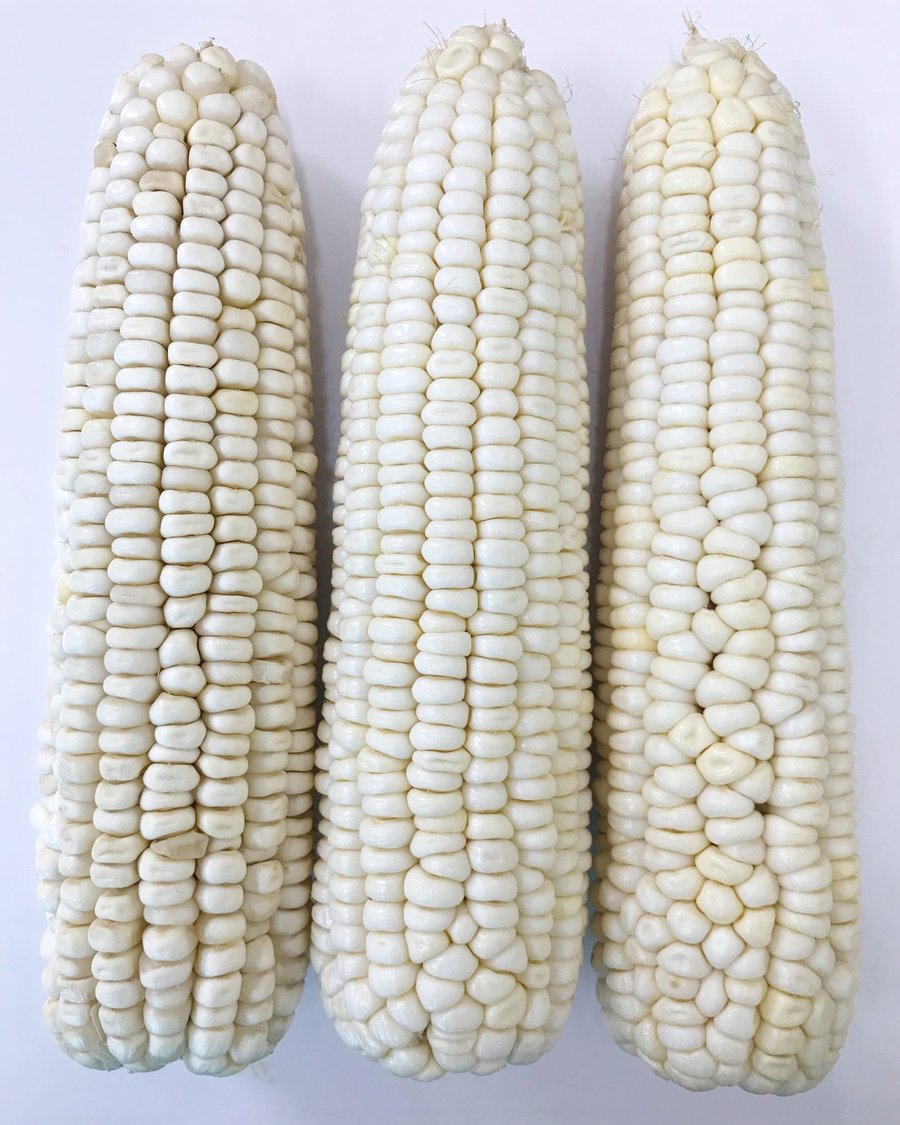
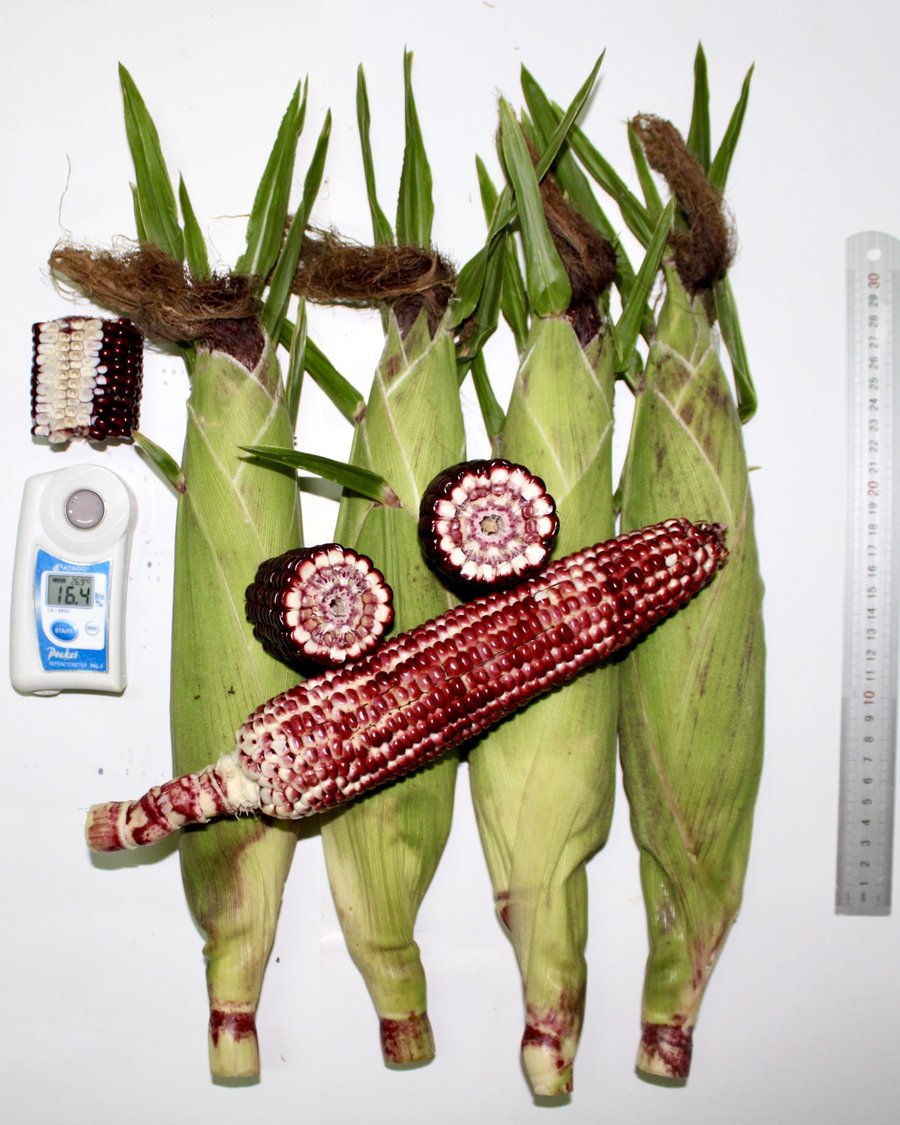
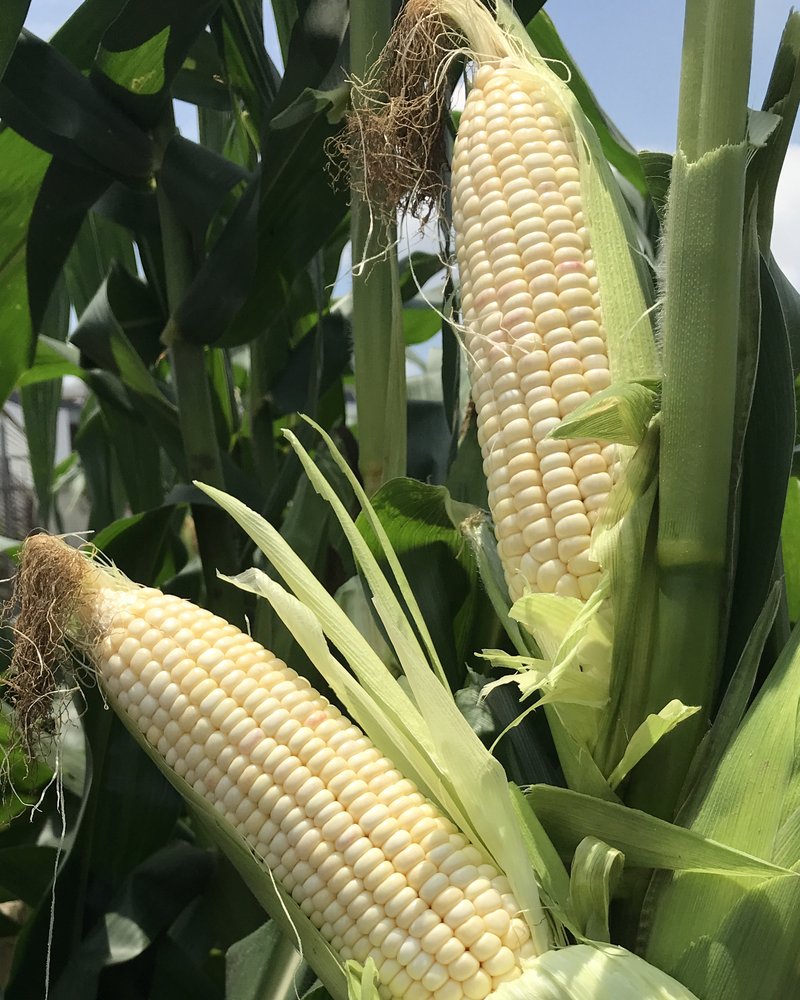
Edible maize (sweet, waxy and other specialty corn) is bred for eating quality as much as for yield. The genes behind that quality are mapped; progress now depends on the stage of breeding a program works at.

Panel a: map of 49 key genes of edible maize on maize chromosomes 1 to 10 of the B73 reference genome. Starch and sugar (sweet, waxy): sh2, bt2, su1, se1, sh1, bt1, wx1, ae1, du1, su2, sbe1, zpu1, sus1, mn1, sweet4c; Nutritional quality: o2, fl2, o1, y1, lcyE, crtRB1, vte4; Anthocyanin and pericarp color: c1, r1, pl1, b1, p1, a1, a2, c2, bz1, pr1, in1; Plant type, flowering and domestication: tb1, tga1, d8, br2, d3, ZmCCT, ZmRap2.7, ra1, krn4, ub3, ZmGa1; Disease resistance: Htn1, Ht1, Rp1, Scmv1, Scmv2.Chr1308.5 Mbp1 (pericarp color1), chromosome 1, 48.0 Mb. Red pericarp/cob; tandem copies in B73.p1br2 (brachytic2), chromosome 1, 206.6 Mb. Semi-dwarf stature.br2tb1 (teosinte branched1), chromosome 1, 272.3 Mb. Tillering/prolificacy; baby corn and multi-ear types.tb1d8 (dwarf plant8), chromosome 1, 272.7 Mb. Plant height/flowering.d8Chr2243.7 Mbb1 (colored plant1), chromosome 2, 19.8 Mb. Plant anthocyanin.b1mn1 (miniature seed1), chromosome 2, 58.7 Mb. Kernel filling and seed weight.mn1zpu1 (pullulanase-type starch debranching enzyme1), chromosome 2, 111.8 Mb. Starch degradation/structure; interacts with su1.zpu1Ht1 (Helminthosporium turcicum resistance1), chromosome 2, 221.0 Mb. Northern corn leaf blight resistance.Ht1se1 (sugary-enhancer1), chromosome 2, 236.3 Mb. Raises sugar and tenderness in su1 background (se/SE types).se1Chr3238.0 MbScmv2 (auxin binding protein1), chromosome 3, 135.5 Mb. Sugarcane mosaic virus resistance.Scmv2a1 (anthocyaninless1), chromosome 3, 221.8 Mb. Anthocyanin; tightly linked to sh2 on chr3.a1sh2 (shrunken2), chromosome 3, 221.9 Mb. Supersweet (sh2) sweet corn; main gene in commercial fresh/processing hybrids.sh2Chr4250.3 MbZmGa1 (-), chromosome 4, 9.8 Mb. Unilateral cross-incompatibility (popcorn Ga1-S); seed purity of specialty corn.ZmGa1fl2 (floury2), chromosome 4, 23.0 Mb. Kernel protein/texture.fl2su1 (sugary1), chromosome 4, 43.4 Mb. Standard sweet corn (su1); also in su1/se1 'sugary enhanced' types.su1tga1 (teosinte glume architecture1), chromosome 4, 46.6 Mb. Naked kernel (domestication).tga1bt2 (brittle endosperm2), chromosome 4, 61.6 Mb. Alternative supersweet type (bt2).bt2o1 (opaque endosperm1), chromosome 4, 181.9 Mb. Kernel vitreousness.o1c2 (colorless2), chromosome 4, 198.7 Mb. Flavonoid/anthocyanin.c2krn4 (kernel row number4), chromosome 4, 205.3 Mb. Kernel row number.krn4ub3 (unbranched3), chromosome 4, 205.4 Mb. Kernel row number / tassel branching.ub3Chr5226.4 Mbsbe1 (starch branching enzyme1), chromosome 5, 65.2 Mb. Starch fine structure.sbe1a2 (anthocyaninless2), chromosome 5, 68.1 Mb. Anthocyanin.a2bt1 (brittle endosperm1), chromosome 5, 115.3 Mb. Brittle1 sweet types; starch accumulation.bt1sweet4c (sugars will eventually be exported transporter4c), chromosome 5, 130.3 Mb. Seed filling (sugar transport to endosperm).sweet4cae1 (amylose extender1), chromosome 5, 171.8 Mb. Amylose-extender; high-amylose and specialty starch; combined with wx/su1.ae1pr1 (red aleurone1), chromosome 5, 183.7 Mb. Purple vs red aleurone.pr1vte4 (vitamin E synthesis4), chromosome 5, 208.4 Mb. Vitamin E (alpha-tocopherol).vte4Chr6181.4 MbScmv1 (resistance to sugarcane mosaic virus1), chromosome 6, 19.6 Mb. Sugarcane mosaic virus resistance.Scmv1y1 (yellow endosperm1), chromosome 6, 91.6 Mb. Yellow vs white endosperm (carotenoids).y1pl1 (purple plant1), chromosome 6, 119.9 Mb. Purple plant/husk; purple corn.pl1su2 (sugary2), chromosome 6, 124.0 Mb. Sugary2; altered starch gelatinisation.su2Chr7185.8 Mbo2 (opaque endosperm2), chromosome 7, 11.0 Mb. Quality-protein maize (QPM): higher lysine/tryptophan.o2in1 (intensifier1), chromosome 7, 19.9 Mb. Anthocyanin intensity.in1ra1 (ramosa1), chromosome 7, 115.0 Mb. Inflorescence/ear branching.ra1Chr8182.4 MbZmRap2.7 (rap2.7 orthologue), chromosome 8, 135.7 Mb. Flowering time.ZmRap2.7lcyE (lycopene epsilon cyclase1), chromosome 8, 142.6 Mb. Provitamin A biofortification.lcyEHtn1 (Helminthosporium turcicum resistanceN1), chromosome 8, 156.1 Mb. Northern corn leaf blight resistance.Htn1Chr9163.0 Mbc1 (colored aleurone1), chromosome 9, 11.1 Mb. Purple/coloured kernels.c1sh1 (shrunken1), chromosome 9, 12.8 Mb. Shrunken1 kernels; novel Sh1 allele reported for sweet corn.sh1bz1 (bronze1), chromosome 9, 13.1 Mb. Anthocyanin (bronze1).bz1wx1 (waxy1), chromosome 9, 25.1 Mb. Waxy (glutinous) corn: amylopectin-only starch.wx1d3 (dwarf plant3), chromosome 9, 28.8 Mb. Plant height.d3sus1 (sucrose synthase1), chromosome 9, 127.8 Mb. Sucrose cleavage in developing kernel.sus1Chr10152.4 MbRp1 (resistance to Puccinia sorghi1), chromosome 10, 2.8 Mb. Common rust resistance (important in sweet corn).Rp1du1 (dull endosperm1), chromosome 10, 60.5 Mb. Dull endosperm; modifier of sweet/waxy kernel texture.du1ZmCCT (CO CO-LIKE TIMING OF CAB1 protein domain1), chromosome 10, 96.2 Mb. Photoperiod sensitivity: tropical vs temperate adaptation.ZmCCTcrtRB1 (hydroxylase3), chromosome 10, 138.7 Mb. Provitamin A biofortification.crtRB1r1 (plant color component at R1), chromosome 10, 141.2 Mb. Purple/coloured kernels and plant.r1 Panel a: map of 49 key genes of edible maize on maize chromosomes 1 to 10 of the B73 reference genome. Starch and sugar (sweet, waxy): sh2, bt2, su1, se1, sh1, bt1, wx1, ae1, du1, su2, sbe1, zpu1, sus1, mn1, sweet4c; Nutritional quality: o2, fl2, o1, y1, lcyE, crtRB1, vte4; Anthocyanin and pericarp color: c1, r1, pl1, b1, p1, a1, a2, c2, bz1, pr1, in1; Plant type, flowering and domestication: tb1, tga1, d8, br2, d3, ZmCCT, ZmRap2.7, ra1, krn4, ub3, ZmGa1; Disease resistance: Htn1, Ht1, Rp1, Scmv1, Scmv2.Chr1308.5 Mbp1 (pericarp color1), chromosome 1, 48.0 Mb. Red pericarp/cob; tandem copies in B73.p1br2 (brachytic2), chromosome 1, 206.6 Mb. Semi-dwarf stature.br2tb1 (teosinte branched1), chromosome 1, 272.3 Mb. Tillering/prolificacy; baby corn and multi-ear types.tb1d8 (dwarf plant8), chromosome 1, 272.7 Mb. Plant height/flowering.d8Chr2243.7 Mbb1 (colored plant1), chromosome 2, 19.8 Mb. Plant anthocyanin.b1mn1 (miniature seed1), chromosome 2, 58.7 Mb. Kernel filling and seed weight.mn1zpu1 (pullulanase-type starch debranching enzyme1), chromosome 2, 111.8 Mb. Starch degradation/structure; interacts with su1.zpu1Ht1 (Helminthosporium turcicum resistance1), chromosome 2, 221.0 Mb. Northern corn leaf blight resistance.Ht1se1 (sugary-enhancer1), chromosome 2, 236.3 Mb. Raises sugar and tenderness in su1 background (se/SE types).se1Chr3238.0 MbScmv2 (auxin binding protein1), chromosome 3, 135.5 Mb. Sugarcane mosaic virus resistance.Scmv2a1 (anthocyaninless1), chromosome 3, 221.8 Mb. Anthocyanin; tightly linked to sh2 on chr3.a1sh2 (shrunken2), chromosome 3, 221.9 Mb. Supersweet (sh2) sweet corn; main gene in commercial fresh/processing hybrids.sh2Chr4250.3 MbZmGa1 (-), chromosome 4, 9.8 Mb. Unilateral cross-incompatibility (popcorn Ga1-S); seed purity of specialty corn.ZmGa1fl2 (floury2), chromosome 4, 23.0 Mb. Kernel protein/texture.fl2su1 (sugary1), chromosome 4, 43.4 Mb. Standard sweet corn (su1); also in su1/se1 'sugary enhanced' types.su1tga1 (teosinte glume architecture1), chromosome 4, 46.6 Mb. Naked kernel (domestication).tga1bt2 (brittle endosperm2), chromosome 4, 61.6 Mb. Alternative supersweet type (bt2).bt2o1 (opaque endosperm1), chromosome 4, 181.9 Mb. Kernel vitreousness.o1c2 (colorless2), chromosome 4, 198.7 Mb. Flavonoid/anthocyanin.c2krn4 (kernel row number4), chromosome 4, 205.3 Mb. Kernel row number.krn4ub3 (unbranched3), chromosome 4, 205.4 Mb. Kernel row number / tassel branching.ub3Chr5226.4 Mbsbe1 (starch branching enzyme1), chromosome 5, 65.2 Mb. Starch fine structure.sbe1a2 (anthocyaninless2), chromosome 5, 68.1 Mb. Anthocyanin.a2bt1 (brittle endosperm1), chromosome 5, 115.3 Mb. Brittle1 sweet types; starch accumulation.bt1sweet4c (sugars will eventually be exported transporter4c), chromosome 5, 130.3 Mb. Seed filling (sugar transport to endosperm).sweet4cae1 (amylose extender1), chromosome 5, 171.8 Mb. Amylose-extender; high-amylose and specialty starch; combined with wx/su1.ae1pr1 (red aleurone1), chromosome 5, 183.7 Mb. Purple vs red aleurone.pr1vte4 (vitamin E synthesis4), chromosome 5, 208.4 Mb. Vitamin E (alpha-tocopherol).vte4Chr6181.4 MbScmv1 (resistance to sugarcane mosaic virus1), chromosome 6, 19.6 Mb. Sugarcane mosaic virus resistance.Scmv1y1 (yellow endosperm1), chromosome 6, 91.6 Mb. Yellow vs white endosperm (carotenoids).y1pl1 (purple plant1), chromosome 6, 119.9 Mb. Purple plant/husk; purple corn.pl1su2 (sugary2), chromosome 6, 124.0 Mb. Sugary2; altered starch gelatinisation.su2Chr7185.8 Mbo2 (opaque endosperm2), chromosome 7, 11.0 Mb. Quality-protein maize (QPM): higher lysine/tryptophan.o2in1 (intensifier1), chromosome 7, 19.9 Mb. Anthocyanin intensity.in1ra1 (ramosa1), chromosome 7, 115.0 Mb. Inflorescence/ear branching.ra1Chr8182.4 MbZmRap2.7 (rap2.7 orthologue), chromosome 8, 135.7 Mb. Flowering time.ZmRap2.7lcyE (lycopene epsilon cyclase1), chromosome 8, 142.6 Mb. Provitamin A biofortification.lcyEHtn1 (Helminthosporium turcicum resistanceN1), chromosome 8, 156.1 Mb. Northern corn leaf blight resistance.Htn1Chr9163.0 Mbc1 (colored aleurone1), chromosome 9, 11.1 Mb. Purple/coloured kernels.c1sh1 (shrunken1), chromosome 9, 12.8 Mb. Shrunken1 kernels; novel Sh1 allele reported for sweet corn.sh1bz1 (bronze1), chromosome 9, 13.1 Mb. Anthocyanin (bronze1).bz1wx1 (waxy1), chromosome 9, 25.1 Mb. Waxy (glutinous) corn: amylopectin-only starch.wx1d3 (dwarf plant3), chromosome 9, 28.8 Mb. Plant height.d3sus1 (sucrose synthase1), chromosome 9, 127.8 Mb. Sucrose cleavage in developing kernel.sus1Chr10152.4 MbRp1 (resistance to Puccinia sorghi1), chromosome 10, 2.8 Mb. Common rust resistance (important in sweet corn).Rp1du1 (dull endosperm1), chromosome 10, 60.5 Mb. Dull endosperm; modifier of sweet/waxy kernel texture.du1ZmCCT (CO CO-LIKE TIMING OF CAB1 protein domain1), chromosome 10, 96.2 Mb. Photoperiod sensitivity: tropical vs temperate adaptation.ZmCCTcrtRB1 (hydroxylase3), chromosome 10, 138.7 Mb. Provitamin A biofortification.crtRB1r1 (plant color component at R1), chromosome 10, 141.2 Mb. Purple/coloured kernels and plant.r1
  • Starch and sugar (sweet, waxy)
  • Nutritional quality
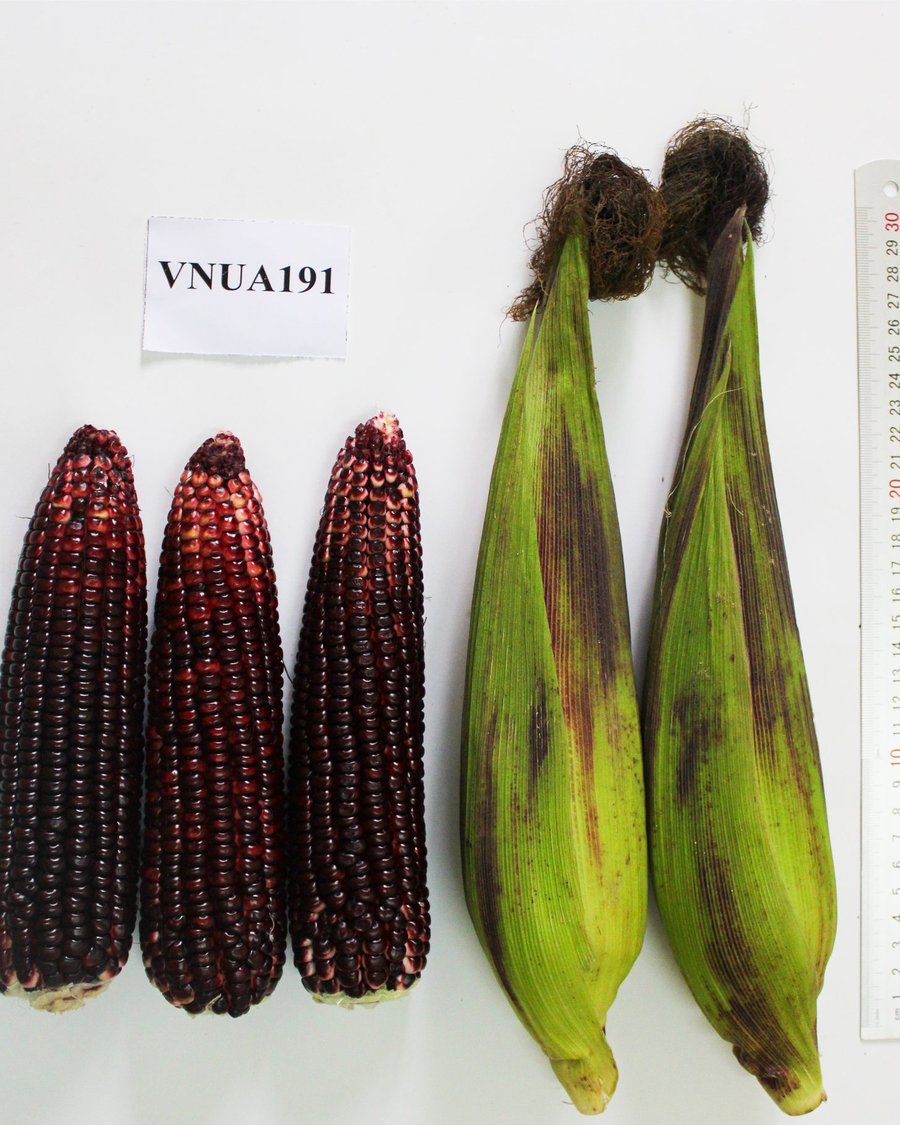
  • Anthocyanin and pericarp color
  • Plant type, flowering and domestication
  • Disease resistance
Schematic of five maize plants of uneven height, as in a farmer's open-pollinated variety

Breeding 1.0

Farmer selection

Farmers kept sweet and glutinous mutants. Five known sugary1 alleles arose independently, two of them in the Andean landrace Chullpi and in Maíz Dulce from Mexico, and waxy maize was first found in China in 1908.

VNUA 160 local waxy maize accessions and 36 exotic sources assembled since 2003.

Schematic of five maize plants of equal height, as in a single-cross hybrid

Breeding 2.0

Crosses, statistics and hybrids

Endosperm genes were bred into inbred lines and hybrids. The first supersweet (sh2) hybrid, Illini Xtra Sweet, was released in 1961, and sh2 is now in most hybrids for the fresh and processing markets.

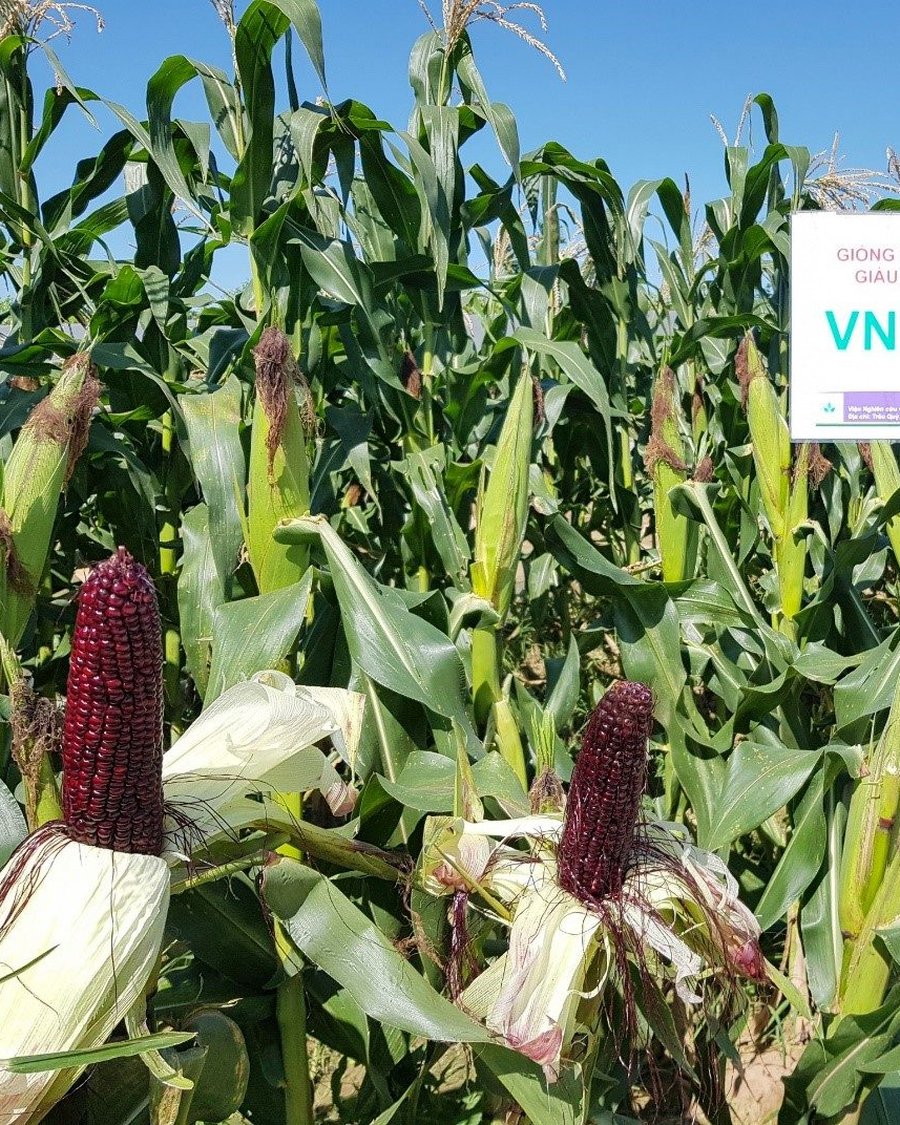
VNUA Five co-developed hybrids recognized since 2022, chosen by combining ability and multi-trait indices. Like most programs in developing countries, the work is still mainly at this stage.

Schematic of five maize plants with genotype squares beneath them; two plants are highlighted as selected

Breeding 3.0

Markers and genomic selection

Markers read the endosperm genes directly, and a 5,759-SNP array predicted kernel weight and size in 277 fresh waxy maize lines with accuracies of 0.33 to 0.64.

VNUA SSR markers linked to sh2 and su1, and a first doubled-haploid test with the inducer UH400.

Schematic of three maize plants, the middle one framed by a camera, above a chromosome with one edited gene marked

Breeding 4.0

Genomes, editing, phenomics and machine learning

A sweet corn reference genome resolved the supersweet allele sh2-R, and CRISPR-edited waxy hybrids outyielded introgressed ones by 5.5 bushels per acre across 25 locations.

VNUA Image-based phenotyping and machine learning predicted rice nitrogen use efficiency with R² 0.98; maize is next.

Schematic of a maize plant and its dashed digital twin on a screen, joined by arrows in both directions

Breeding 5.0

AI-centered breeding (proposed)

Proposed by several authors: foundation models, automated data collection, simulated breeding environments and explainable AI.

VNUA A breeding digital twin that predicts each selection on quality, yield, and nitrogen and phosphorus use efficiency, and audits it against later trials.

a, Start positions of 49 genes that define or improve edible maize on chromosomes 1–10 of the B73 reference genome (RefGen_v5, MaizeGDB gene models), drawn to one scale; color and marker shape give the trait category. Tightly linked genes that matter in breeding include a1–sh2 on chromosome 3, the reason purple supersweet corn is hard to breed. b, Stages of plant breeding, 1.0 to 4.0 after Wallace et al. (2018) and Aggarwal et al. (2026), with Breeding 5.0 as proposed; each card gives a milestone in edible maize and the position of the VNUA program. Plant silhouette: Onsemeliot, PhyloPic (public domain).

Sources: Hu et al. 2021, Nat. Commun.; Zheng et al. 2013, PLoS ONE; Tracy et al. 2019, Plant Breed. Rev.; Anirban et al. 2023, Sci. Rep.; Qu et al. 2026, Plants; Gao et al. 2020, Nat. Biotechnol.; Wallace et al. 2018, Annu. Rev. Genet.; Aggarwal et al. 2026, Theor. Appl. Genet.; MaizeGDB, B73 RefGen_v5.

Nguyen Trung Duc is a co-author of 5 VNUA corn hybrids that are officially recognized for circulation.
Press Esc to close.